10 SEO Strategies Every Small Business Should Use
In today’s digital world, having a website is not enough. Your potential customers need to find your business online when they search for products or services you offer.
That’s where Search Engine Optimization (SEO) comes in.
SEO helps improve your website’s visibility in search engines, attract relevant visitors, build credibility, and generate more opportunities for your business.
For small businesses, SEO can be especially valuable because it can help you compete for visibility without relying entirely on paid advertising.
Here are 10 SEO strategies every small business should use to improve its online presence.
1. Target the Right Keywords
Keywords are the words and phrases people type into search engines when looking for information, products, or services.
Instead of targeting only broad keywords such as “digital marketing,” consider more specific phrases such as:
- Digital marketing agency for small businesses
- SEO services for local businesses
- Digital marketing agency in Kerala
- Affordable SEO services
Focus on keywords that match your products, services, location, and customer needs.
Tip:
Look for keywords with clear search intent rather than choosing keywords simply because they have high search volume.
2. Optimize Your Google Business Profile
If your business serves a specific location, local SEO should be a priority.
A properly optimized Google Business Profile can help your business appear in local search results and Google Maps.
Make sure your profile includes:
- Accurate business name
- Correct address
- Phone number
- Website
- Business hours
- Relevant business category
- High-quality photos
- Services or products
- Regular updates
Encourage genuine customers to leave reviews and respond professionally to reviews you receive.
3. Create High-Quality Content
Content is one of the most effective ways to attract potential customers through search engines.
Instead of creating content only to fill your website, answer the questions your target customers are actually asking.
For example, a digital marketing agency could create articles such as:
- What is SEO?
- How much does SEO cost?
- SEO vs. Google Ads
- How to improve Google rankings
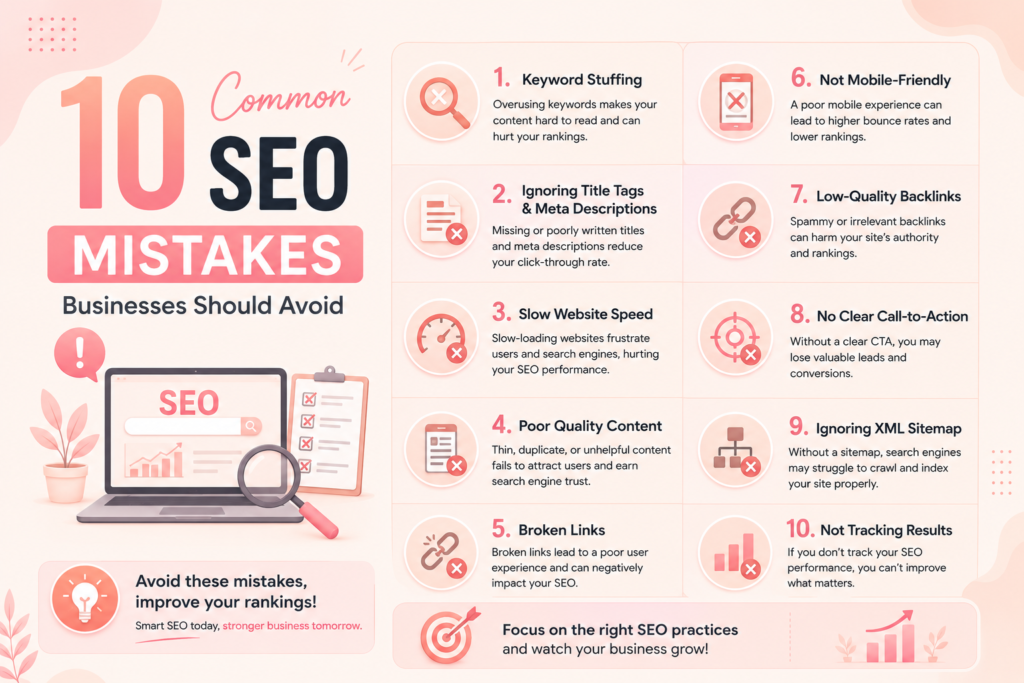
- Common SEO mistakes small businesses make
Useful content can attract search traffic while also demonstrating your expertise.
4. Optimize Your Website Pages
Every important page on your website should be optimized for both search engines and users.
Pay attention to:
- Page titles
- Meta descriptions
- Headings
- URLs
- Keyword placement
- Internal links
- Image alt text
- Readability
Avoid keyword stuffing. Your content should sound natural and provide genuine value to visitors.
5. Improve Your Website Speed
Nobody likes waiting for a slow website.
Website performance can affect the user experience and contribute to how well your site performs in search.
To improve your website speed:
- Compress large images
- Reduce unnecessary scripts
- Use efficient hosting
- Minimize unused website elements
- Keep plugins and software updated
- Optimize mobile performance
A faster website can help visitors find information and take action more easily.
6. Make Your Website Mobile-Friendly
A large portion of online browsing happens on smartphones.
Your website should look good and function properly across different screen sizes.
Check that:
- Text is easy to read
- Buttons are easy to tap
- Menus work correctly
- Images fit the screen
- Forms are easy to complete
- Pages load efficiently
A mobile-friendly website isn’t just good for SEO—it creates a better experience for potential customers.
7. Build Quality Backlinks
Backlinks are links from other websites pointing to your website.
Search engines can use links as signals when evaluating website authority, but quality matters more than quantity.
Small businesses can earn relevant backlinks by:
- Publishing useful resources
- Partnering with local organizations
- Contributing expert articles
- Getting listed in reputable industry directories
- Creating original research or useful guides
- Building relationships with relevant websites
Avoid buying large quantities of low-quality links. Poor link-building practices can create more problems than benefits.
8. Use Internal Linking
Internal links connect one page of your website to another.
For example, a blog about SEO strategies could link to your:
SEO Services → Contact Page → Related SEO Articles
Internal linking helps visitors discover more content and makes it easier for search engines to understand the structure and relationships between your pages.
Simple Tip:
Whenever you publish a new blog post, look for relevant older articles or service pages that you can naturally link to.
9. Focus on Local SEO
For businesses that serve a particular city, region, or service area, local SEO can be extremely important.
Optimize your website for relevant local searches such as:
“SEO agency in Kochi”
“Digital marketing services in Kerala”
“Web design company near me”
Create useful location-specific content and make sure your business information is consistent across relevant online platforms.
10. Track Your SEO Performance
SEO isn’t a one-time activity.
You need to monitor your results and understand what’s working.
Keep an eye on metrics such as:
- Organic traffic
- Keyword rankings
- Search impressions
- Click-through rate
- Leads generated
- Conversions
- Top-performing pages
Use your data to identify opportunities and improve your strategy over time.
Bonus Tip: Be Patient and Consistent
One of the biggest SEO mistakes small businesses make is expecting instant results.
SEO generally takes time because search engines need to discover, understand, and evaluate your website and its content.
Instead of looking for quick fixes, focus on consistently improving:
Content + Technical SEO + User Experience + Authority + Local Visibility
Over time, these efforts can create a stronger foundation for organic growth.
Final Thoughts
SEO doesn’t have to be complicated or reserved for large companies.
By focusing on the fundamentals—keyword research, quality content, local SEO, website optimization, backlinks, mobile performance, and continuous measurement—small businesses can build a stronger online presence and reach more potential customers.
The most important thing is to start with a clear strategy and consistently improve it.
🚀 Ready to Improve Your Google Rankings?
Don’t let your competitors take all the online visibility.
Our SEO experts can help your business build a custom SEO strategy designed to increase visibility, attract the right audience, and generate more qualified leads.
👉 Get Your Free SEO Consultation Today
Contact us today to discover how SEO can help your small business grow online.
📈 Improve your visibility. Attract more customers. Grow your business.
Let’s get your business found on Google!